Posted

Hans Leaman serves as Academic Dean and Associate Professor of History at Sattler College. As an educator in the fields of both history and law, he has been working to build a pipeline of future teachers inspired to integrate the insights of classical virtue education with Anabaptist ideals of Christian discipleship and conflict resolution.
After graduating from LM in 1996, Hans headed to Princeton University for college. Graduating summa cum laude, he continued his studies at Yale University as a Jacob K. Javits Fellow, first earning a J.D. from Yale Law School and then a Ph.D. in history and Renaissance Studies.
Hans first worked as an attorney in Washington, D.C. for the international law firm, Sidley Austin. Later he taught Renaissance and Reformation history and political theory as a postdoctoral fellow at Yale. In response to the rapidly growing numbers of displaced people in the 2010s, he also developed new courses for Yale College on refugee and migration studies. This initiative built upon his experience working pro bono as a legal advocate on behalf of refugees and asylum-seekers.
Shortly after the German government made the politically controversial decision to admit over one million refugees fleeing the civil war in Syria, Hans joined the Max Planck Institute for the Study of Religious and Ethnic Diversity in Göttingen (Ethics, Law & Politics Department) to help research matters related to international refugee law, religious freedom, and the experiences of religious minorities in western societies.
In 2018, he became part of the founding faculty for a new Christian college in downtown Boston—Sattler College. Named for Michael and Margaretha Sattler, two early Anabaptist leaders in the Reformation era, the college has aimed to provide a classics-oriented liberal arts education in an environment supportive of values found in the life of the early church and the early Anabaptist movements. To accompany the college’s requirements that all students learn Biblical Greek and Hebrew, Hans developed a core curriculum that immerses students in a cohesive study of timeless works of philosophy, theology, literature, and art from ancient Greece and Rome; medieval, Renaissance, and post-Reformation Europe; and the early American republic. This work reflects his broader commitment to helping others understand the enduring relevance of Anabaptist history.
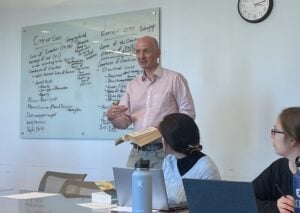 At Sattler College, he relishes the opportunity to help many first-generation college students develop a sense of their place within the history of the church and contribute to its mission. Hans reflected that when we join the church, rooted and abiding in Christ, we become like a “new branch on a larger tree, supported when we recall the faith of Christians who weathered trials before us and draw on it for inspiration.”
In recent years, Hans has been deeply engaged in studying and sharing Anabaptist history. Last year, he spoke at the Mennonite World Conference in Switzerland during the 500 Years of Anabaptism commemoration. In a workshop titled “What Anabaptist Migration Has to Tell Us Today,” he reflected on how Anabaptist stories of exile and movement still shape the church’s witness today.
Hans is currently completing a book manuscript on how early Anabaptists understood exile and migration through the Bible and their own experiences. Since fall 2024, he has also been writing a weekly series of essays at Sattler College called “The Reformation at 500,” which traces the birth of the Anabaptist movement exactly 500 years after each historical event occurred. Together, these essays will form a book-length history of early Anabaptism.
He and his wife, Kara, are the parents of current LM students, Elliot and Thaddeus, as well as their younger daughter, Anna. Though Hans’ life has taken many different turns, the connecting thread between each step of his journey is a desire to foster conflict resolution and the virtues of justice and compassion.
He was selected to receive the honor of Alumnus of the Year because of his dedication and commitment to using the passions and gifts God has given him to serve others and glorify God. We are grateful for the ways Hans is inspiring the next generation to go and do likewise.
Hans shared that his experience at Lancaster Mennonite shaped his understanding of what it means to be a global citizen and peacemaker. He was inspired by faculty who had lived and served in many places around the world and named their direct experience and perspective as important in helping him imagine the ways others lived and worshiped God. He fondly recalls being part of student council, touring and singing with Campus Chorale in Kenyan and South African churches, and participating in two musicals including, The Sound of Music during his time as an LMH student.
Hans names two reasons why he felt the field of history was worth his time in response to his call to follow Jesus:
In Deuteronomy 4, Moses instructs the people to “not forget the things your eyes have seen or let them fade from your heart as long as you live. Teach them to your children and to their children after them.” Throughout Biblical history, we see honest accounts of the failures of humanity in following God’s ways. We also see the amazing acts of people faithfully following God, and we see God’s marvelous deeds, mercy, and desire for reconciliation. History is a way to give people a greater sense of humility in light of God’s activity in their lives and to connect them to God’s long arc of connection to humanity.
In reflecting on his role as a history professor, Hans said, “The main skill set I’m trying to pass on is empathy. Equipping students to think beyond their own experience and to consider, ‘how would I respond if I were living in the context of the person I’m reading about?’” This skill is transferable into current relationships as curiosity and empathy lead us to demonstrate Jesus’ love and care for others.